
What is a Certified Interior Designer?
In a previous post, we discussed what makes an interior designer and how it’s regulated as an industry, or the lack there of. Today we’re jumping into the NCIDQ certification; the good, the bad, and the ugly.
Within the industry, there are varying opinions about what should be allowed, what should be required, and what the exam should cover. Let’s start by reviewing the current industry legislation:
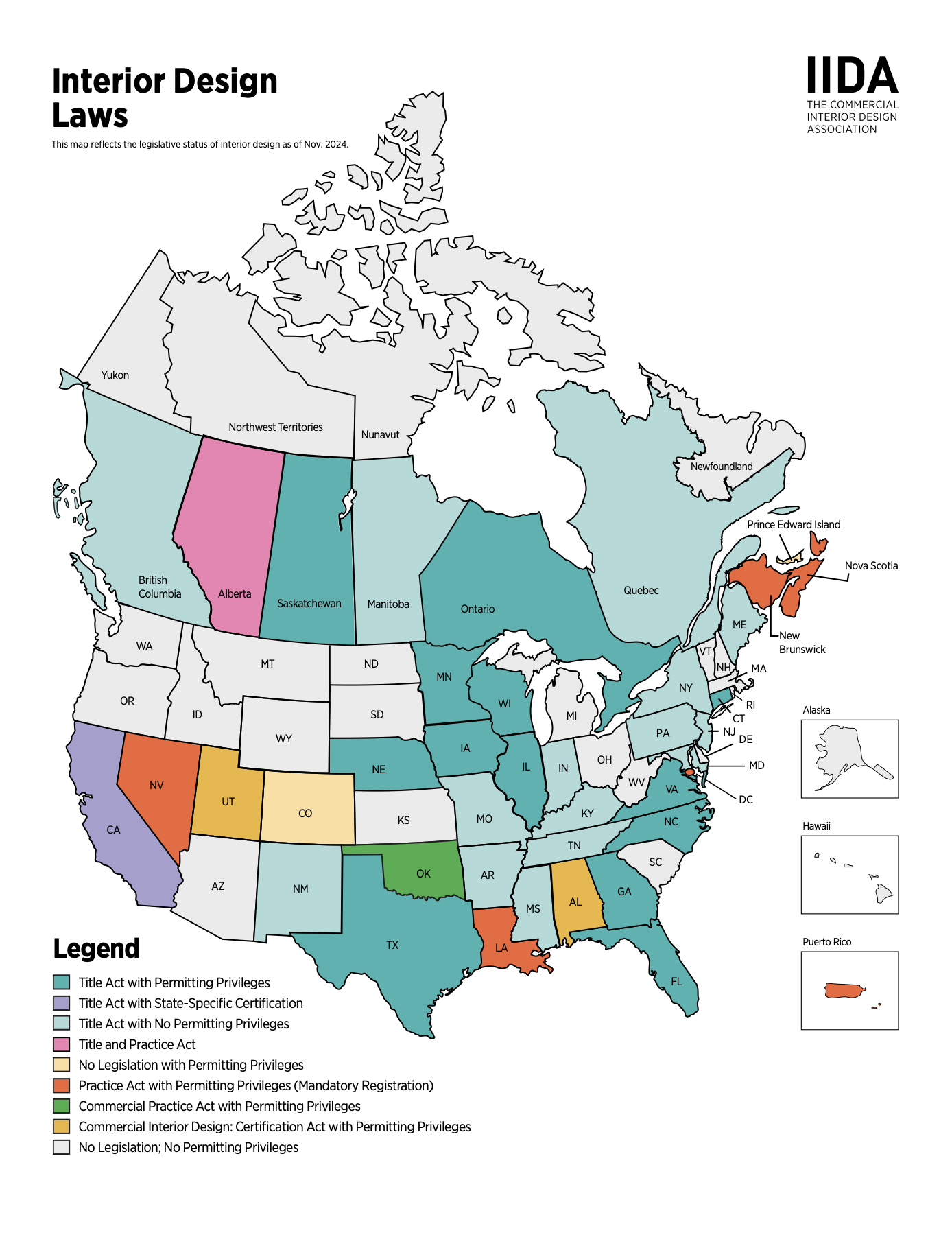
This map is provided by the IIDA, International Interior Design Association.
The above map shows how twenty-five of US states have zero legislation for the industry. Anyone can wake up tomorrow and call themselves an interior designer. I’ve actually been told by a construction manager that they’re an interior designer…they had zero experience or education designing interiors.
So, what do these protections mean for the states with laws?

Practice Act
A law that prohibits the actual practice of interior design services without registration or licensure by the practitioner.
For Example
This means you cannot legally provide services or you could be committing a criminal offense and be heavily fined.
This is the highest and strongest protection for public safety.

Title Act
A law that means you can’t use specific words or titles with legally defined meanings.
For Example
“registered interior designer”,
“certified interior designer”
“licensed interior designer”
even simply “interior designer” is protected in some areas.
Some states have one or the other or both. In looking at the colorful map above, we’re able to see just how varied these laws have become and with a lack of consistency, there is also a lack of agreement.
Designers often feel frustrated trying to define what makes a “true” designer, most of these discussions look like the image below…but the one gold standard everyone can agree on is the NCIDQ examination.

CIDQ or the Council for Interior Design Qualification, explains the certification test is developed on a “research-based process to ensure fairness, validity, and reliability”, here’s a good video to explain the development of the exam.
So, what does it look like?
First, there are different routes depending on your education and experience. You have to meet all the qualifications and required training hours based on the route you take. Then, you can apply and pay a $235 fee which could result in not even being able to even sit for the exam if they can’t verify your experience or college degree (and you don’t get the fee back if you’re denied).
If you’re approved, the exam is broken down into three sections:
IDFX: The fundamentals, $305 fee // Focuses on programming, conceptual, and schematic design phases.
IDIX: The implementation, $470 fee // Focuses on the design development and construction documentation phases. Formally known as IDPX.
IDPX: The professional, $365 fee // Focuses on the construction administration and project management phases. Formally known as PRAC.
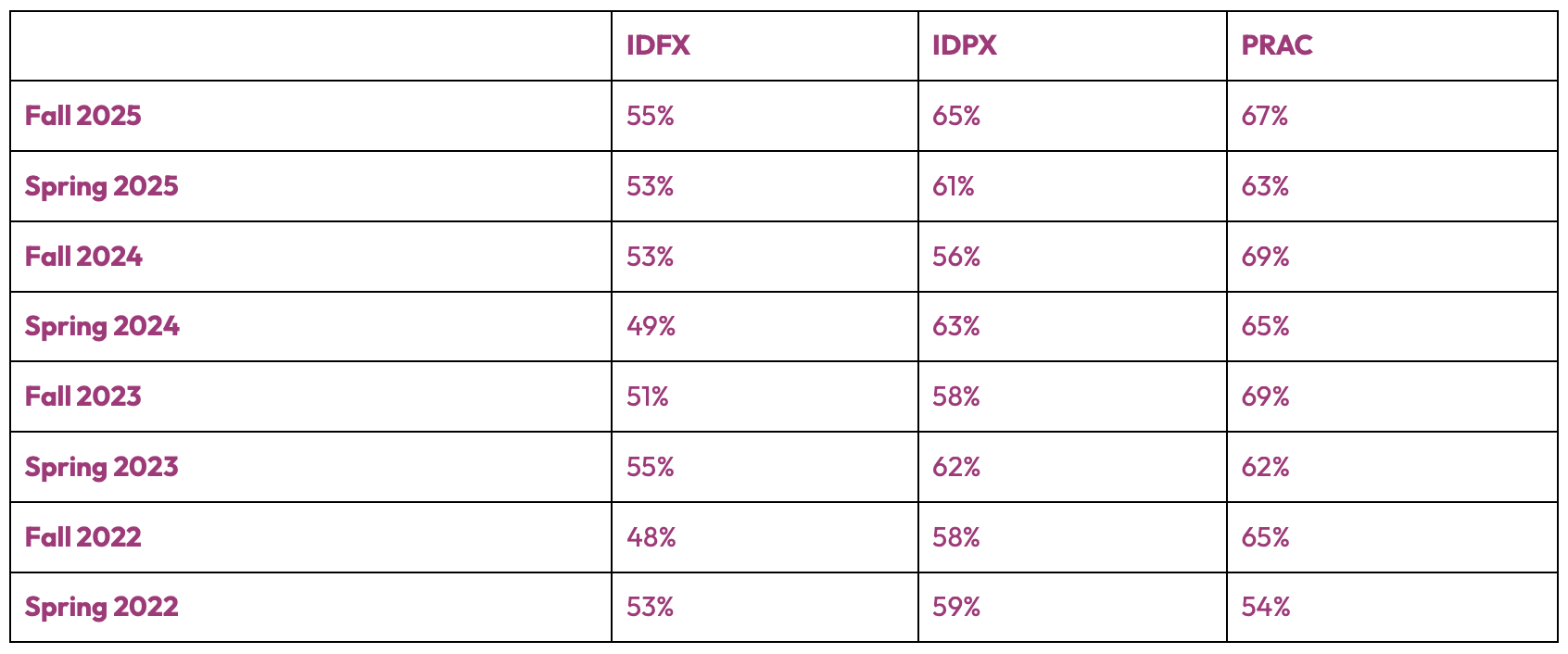
The passing rates for the previous few years are dismal, as shown below. Meaning it’s very likely for candidates to take the exams multiple times before passing.
Let’s break down the pros and cons

The Pros
Professional Credibility: you establish rapport and credibility within the industry. There is no question of designer or decorator when you have those letters behind your name.
Career Advancement: it’s not common to have your NCIDQ (at least in Ohio), which means it boosts your reputation and gives you a step above others during team planning.
Confidence: positive self assurance is priceless. The feeling of knowing your shit is so gratifying. Inner strength allows designers to push limitations and explore creative boundaries.
Recognition: what is better than being able to rightfully put those letters behind your name and be recognized on a national level as one of the top professionals in your trade? The pay bump also helps, the median salary is $16K higher for a certified designer.
Advocacy: interior design is not regulated in most states and certification is the opportunity to fight for your professional field. We are not decorators, we do infinitely more than what HGTV shows. With the certification, even if the laws change, you’re protected and can continue working professionally without worry.

The Cons
Financial Investment: it’s expensive to just take the exams, a total of $1,375 if you pass every exam on the first try. Not to mention study materials, none of which are endorsed or recommended. Qpractice is a third party website that is $159-$199/month. Physical books and mock exams range from $500-$1,000. In total, you’re looking at an investment well over $2,000.
Sponsor Required: applying comes with being sponsored by a licensed designer, architect, and/or NCIDQ certified designer. If you haven’t had the opportunity to work with someone who meets the criteria, you need to find a willing sponsor to verify your experience which can be difficult.
Time restrictive: studying begins five to six months before each exam which can only be taken in April and October. It’s recommended to get two hours of studying a day.
Trick Questions: they state specifically on their website: “…there are no tricks or hidden agendas.” Yet, there are questions with very little context and multiple correct answers but only one is the “most” right in their opinion so you have to be very careful. No wonder the fail rates are so high!

Here’s why I’m sitting for the exam:
I’m going to get the certification so I can secure the company’s future, regardless of what law or act is or isn’t enacted. I have built Damewood from only a dream and a hope; I will not lose it over a new law after years of pouring my heart and soul into creating this design studio. I’m creating a stable, solid foundation for future expansion with a stamp of credibility that even years within the industry just can’t match. With that being said, wish me luck as I embark on this journey of certification, if all goes well, I’ll have those little letters behind my name by mid 2027 🤞🏻
For more information, check out IIDA’s advocacy program and how they’re advancing the industry. If you’d like to know more about why certification matters, check out this video from the CIDQ and stay tuned for updates!
We’ll be sharing more opinion pieces soon but if you have a specific topic you’d like to hear our input on, let us know by emailing emmy@damewooddesigns.com.
Cheers!
xx - Emmy
P.S. Check out our Instagram to keep up with new projects!